Green Sea Turtles: Navigators That Return to the Beach Where They Were Born
Green turtles cross entire oceans and then find their way back to their birth beach decades later. Earth's magnetic field may be their map.
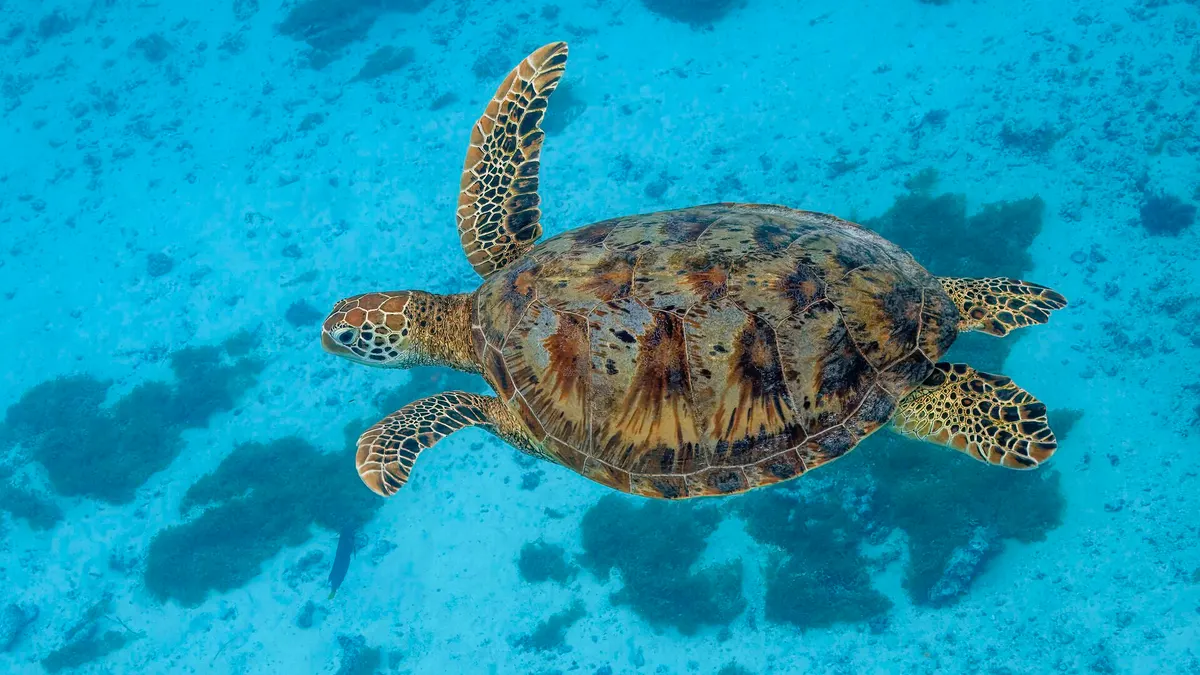
Sea turtles have been swimming in Earth's oceans for over 100 million years. Among the seven living species, the green sea turtle (Chelonia mydas) is one of the most widespread, found in tropical and subtropical waters around the world.
Why "green"?
The name does not come from the shell, which is usually brown or olive. It comes from the greenish colour of the turtle's body fat, which is thought to result from its diet. Adults are mainly herbivores, grazing on seagrass and algae. This grazing helps keep seagrass meadows healthy, much like mowing a lawn encourages new growth.
A remarkable homecoming
Female green turtles typically nest on the same beach region where they themselves hatched, a behaviour called natal homing. They may not return until they reach maturity, which can take 20 to 40 years. Research suggests turtles imprint on the unique magnetic signature of their home coastline and use Earth's magnetic field to find their way back.
Nesting night
At night, a female crawls up the beach, digs a pit with her flippers and lays around 100 eggs before covering them with sand and returning to the sea. She may nest several times in one season. The eggs incubate for about two months. Remarkably, the temperature of the sand determines the sex of the hatchlings: warmer nests produce more females, cooler nests more males.
Rising beach temperatures are causing some turtle populations to produce almost entirely female hatchlings.
The lost years
Hatchlings emerge together, usually at night, and head toward the brightest horizon, which on a natural beach is the ocean. Once in the water they swim out to sea and spend years drifting in the open ocean, often among floating seaweed. Scientists call this period the "lost years" because it is so hard to track such small animals.
How to help
- Keep beaches dark during nesting season; artificial lights can lead hatchlings inland.
- Reduce plastic use. Turtles can mistake plastic bags for jellyfish or algae.
- Watch nesting turtles only from a distance and with licensed guides.
- Choose seafood from fisheries that use turtle-safe gear.
Quick facts
- Shell length: around 80–120 cm in adults
- Weight: commonly 110–190 kg
- Status: Endangered (IUCN)
Keep reading
Signature Whistles: How Bottlenose Dolphins Call Each Other by Name
Each bottlenose dolphin develops a unique whistle that works a lot like a name, and other dolphins can copy it to get its attention.
Octopus Intelligence: Nine Brains, Three Hearts and a Lot of Curiosity
Octopuses solve puzzles, escape tanks and change colour in a blink. Their intelligence evolved completely separately from ours.
The Blue Whale: Inside the Largest Animal That Has Ever Lived
Longer than a basketball court and heavier than any dinosaur, the blue whale survives on some of the smallest animals in the sea. Here is how it works.