The Blue Whale: Inside the Largest Animal That Has Ever Lived
Longer than a basketball court and heavier than any dinosaur, the blue whale survives on some of the smallest animals in the sea. Here is how it works.
In this article
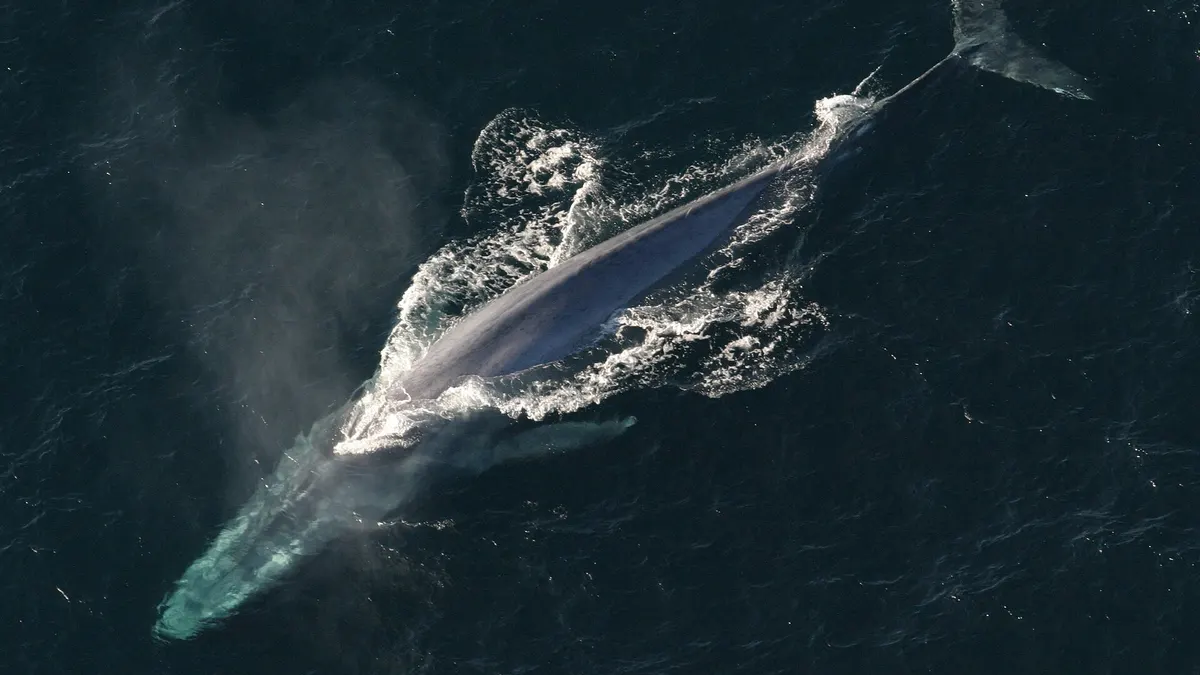
Picture an animal as long as three school buses parked end to end. Its heart is roughly the size of a small car, and a person could crawl through some of its larger blood vessels. That animal is the blue whale (Balaenoptera musculus), and as far as scientists can tell it is the largest creature ever to have lived on Earth, bigger than even the giant sauropod dinosaurs.
Just how big is a blue whale?
Adult blue whales commonly reach 24 to 30 metres (about 80 to 100 feet) in length. The heaviest individuals are estimated at 150 tonnes or more, although weighing an animal this large is extremely difficult, so most numbers come from whaling records in the early twentieth century. Females tend to be slightly larger than males, which is common among baleen whales.
Even the calves are enormous. A newborn blue whale is about 7 metres long and weighs around 2.5 tonnes. During nursing it can gain close to 90 kilograms a day on its mother's fat-rich milk.
A giant that eats tiny food
It seems backwards, but the biggest animal on the planet feeds almost entirely on krill, small shrimp-like crustaceans only a few centimetres long. Blue whales are baleen whales: instead of teeth, they have hundreds of plates of baleen hanging from the upper jaw. Baleen is made of keratin, the same protein in human fingernails.
To feed, a blue whale uses a technique called lunge feeding. It accelerates toward a dense patch of krill, opens its mouth wide and lets pleated throat grooves expand like an accordion. In a single gulp it can take in a volume of water and prey larger than its own body. It then pushes the water out through the baleen, which acts like a sieve and traps the krill inside. During peak feeding season an adult may eat several tonnes of krill in a day.
A single lunge can engulf around 100 tonnes of water, and the whale does this over and over, diving and resurfacing for hours.
The loudest voice in the ocean
Blue whales produce low-frequency calls that are among the loudest sounds made by any animal. Many of these calls are below the range of human hearing. Low-frequency sound travels very long distances underwater, and researchers believe blue whales may be able to hear one another across hundreds of kilometres of open ocean. Different populations have distinct call types, which scientists use to identify which group of whales is present in an area using underwater microphones.
Where blue whales live
Blue whales are found in every ocean except the Arctic. Several subspecies are recognised, including the Antarctic blue whale, the pygmy blue whale of the Indian Ocean and southern Pacific, and the northern hemisphere populations. Most undertake seasonal movements between cold, productive feeding grounds and warmer waters where calves are thought to be born, although their migrations are less predictable than those of humpback or gray whales.
Nearly lost, slowly returning
Commercial whaling in the twentieth century was devastating for blue whales. Once explosive harpoons and factory ships made them catchable, hundreds of thousands were killed. The Antarctic population was reduced to a tiny fraction of its original size. The International Whaling Commission protected blue whales worldwide in 1966.
Today the species is listed as Endangered on the IUCN Red List. Some populations, such as those off California, show signs of recovery, while others remain very small. Modern threats include ship strikes, entanglement in fishing gear, ocean noise and changes in krill availability linked to warming seas.
Quick facts
- Length: typically 24–30 m
- Diet: mostly krill
- Lifespan: estimated 80–90 years
- Status: Endangered (IUCN)
- Heart: can weigh around 180 kg
The blue whale is a reminder that the ocean still holds wonders on a scale that is hard to imagine. Protecting the krill-rich waters it depends on helps an entire food web, not just the giant at the top.
Keep reading
Why Do Humpback Whales Sing? The Science Behind the Ocean's Greatest Songs
Male humpbacks perform long, complex songs that change every year and spread across entire ocean basins. Researchers are still decoding why.
Orcas: Family, Culture and Hunting Strategies of the Killer Whale
Orcas live in tight family groups led by older females, with their own dialects and hunting traditions passed down through generations.
How Sperm Whales Dive Thousands of Metres Into the Dark
Sperm whales hunt squid in total darkness more than a kilometre below the surface. Their bodies are built for pressure most animals could never survive.